
Jun 22, 2026
Moonwatt commissions the first distributed sodium-ion battery system purpose-built for hybrid solar plants
Moonwatt today announced that its first commercial-scale project is live and dispatching power at Cleantech Park Arnhem in the Netherlands. It is the first time a distributed, passively-cooled sodium-ion Battery Energy Storage System (BESS) has been coupled with a ground-mounted solar plant. The company is now booking orders for delivery in 2027 and will present the system at Intersolar Europe in Munich (June 23rd to 25th 2026, Booth C2.190).
At a glance
| 12,000 | Cycles thanks to its sodium-ion chemistry, versus around 7,300 for conventional lithium-ion systems |
| 25% | Less energy lost per cycle, thanks to passive cooling and low-voltage coupling, versus conventional actively-cooled systems |
| Zero | Auxiliary power consumed for thermal management thanks: no fans, no pumps, no moving parts, no noise |
| 1 forklift | Required for complete installation: no foundation, no civil works, no crane, no dedicated transformer |
| AC and DC | Both DC and low-voltage AC coupling topologies proven in the field, eliminating medium-voltage equipment for the storage product |
| 2x faster | Speed up development and deployment with a smaller and modular product |
| Retrofit or new-build | The same product works for retrofitting existing PV plants and for new greenfield projects |
The project: a world first, live in the Netherlands
Moonwatt, a European company based out of Amsterdam, has commissioned its first operational project at Cleantech Park Arnhem in the Netherlands, in partnership with IPKW and Veolia. The system uses Moonwatt’s proprietary passively cooled battery technology.
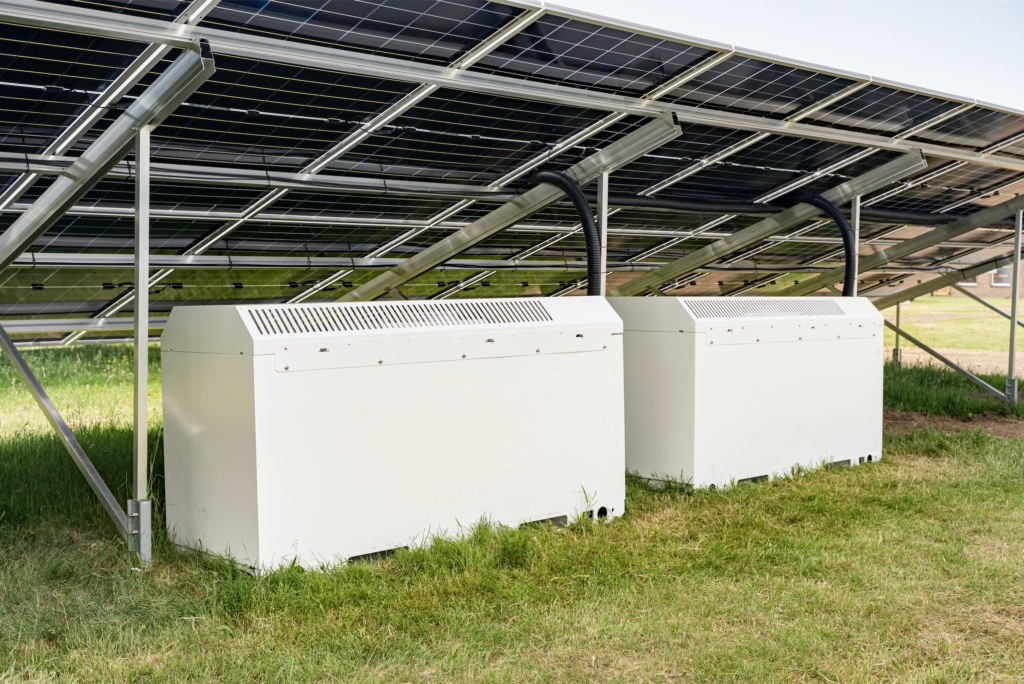
The Arnhem project is the first sodium-ion battery storage system ever directly coupled with a ground-mounted solar plant. The installation runs both Alternating Current (AC) coupled and Direct Current (DC) coupled inverter topologies side by side, proving both electrical architectures in the field with the same Moonpods. In a DC-coupled configuration the battery connects directly to the PV array through a shared hybrid inverter; in an AC-coupled configuration the battery and the PV array use their own respective inverters. The same product addresses both topologies, which makes it suitable for new-build plants and for retrofitting solar assets already in operation.
The 500 kWh project is operating under real grid conditions, dispatching solar energy across the day rather than only when the sun is shining. Commercial-scale deployments across Europe begin in early 2027.
“We have commissioned the first sodium-ion battery system in the world directly coupled with a solar plant. The project is live. This is not a marginal improvement on lithium-ion. It is a storage product designed from the ground up for solar.”
Zukui Hu, CEO, Moonwatt
What it means for solar projects
Moonwatt builds storage purpose-built for solar developers, operators and EPCs. As solar penetration grows, price cannibalisation pushes daytime capture prices down, sometimes into negative territory, while grid congestion slows new connections. Co-locating storage behind the same meter is the practical answer to both, and the Moonpod is designed specifically for it, improving project economics in three places: permitting, CAPEX and OPEX.
Installation: forklift only, no civil works
The Arnhem project proved the point Moonwatt’s engineering team set out to demonstrate: installing storage on a solar plant should take no more equipment or qualification than installing the solar plant itself.
- Delivery: the Moonpod arrives on a standard pallet. No special transport or lifting equipment.
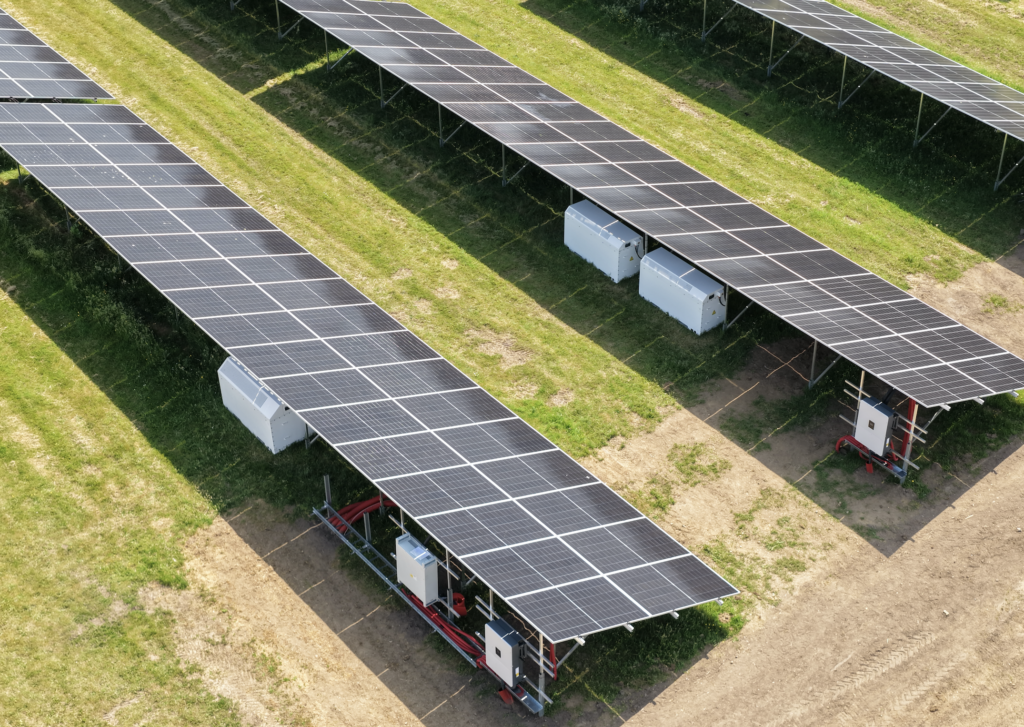
- Placement: the forklift already on site for the PV modules places the unit directly beneath the panels, on land the array already occupies.
- Connection: a DC connection to the hybrid string inverter, running along existing PV cable trays. No trenching, no additional AC runs.
- Infrastructure: no concrete foundation, no dedicated medium-voltage transformer, no crane, no separate battery yard. One hybrid inverter serves both PV and battery instead of two systems.
“The first thing you notice is what isn’t there. No concrete foundations, no crane, no separate battery yard. The Moonpods sit on the soil under the PV modules, and the same forklift the crew is already using for the panels places them. Then it is a simple DC connection to the hybrid inverter, with cabling running along the existing PV structures. No trenching, no extra AC runs. That takes weeks off an EPC’s schedule.”
Greig Swanepoel, Director of Electrical Engineering, Moonwatt
For retrofit projects, the Moonpod connects on the low-voltage DC or AC side of an existing plant without redesigning its electrical architecture and without adding medium-voltage infrastructure. That makes it practical to hybridise operating PV assets as grid conditions tighten across Europe.
Performance: longer life, higher efficiency
Cycle life. The Moonpod is designed for 12,000 cycles at 100% depth of discharge, thanks to its Sodium Iron Phosphate Pyrophosphate (NFPP) cells. Conventional lithium-ion systems, typically built on lithium iron phosphate (LFP), deliver around 7,300 cycles. The crystalline structure of NFPP is more stable, which means lower degradation per cycle and longer reliable operation before capacity replacement thresholds are reached. For a daily-cycling solar asset that also provides ancillary services, that is the difference between replacing the system within the plant’s lifetime or not at all.
Efficiency. Because the Moonpod is passively cooled, it draws no auxiliary power to keep itself running, and its DC-coupled architecture removes conversion steps. The result is up to a 25% reduction in the energy lost per cycle compared with conventional, actively-cooled lithium-ion systems. As batteries grow larger and longer-duration relative to the PV they serve, every unit of energy saved converts directly into shifted energy and revenue over the asset’s lifetime.
Temperature range. Sodium-ion cells cycle efficiently across a wide ambient range without active thermal management, from low winter temperatures to high summer conditions, with minimal performance variation and no efficiency penalty on hot days. Conventional lithium-ion systems need active cooling to hold cells near 25°C degrees, and lose efficiency on the hottest days, exactly when a solar plant is generating most.
“Sodium-ion lets us operate across a much wider temperature range, so we can remove active cooling entirely. No HVAC, no fans, no pumps, and none of their failure points. It is the same shift solar already made from central inverters to string inverters: small, modular and distributed beats large and complex. We brought that approach to storage.”
Guillaume Mancini, CTO, Moonwatt
Operations: less to maintain, less to replace
Moonwatt’s proprietary passive thermal management means the Moonpod has no moving parts and no active cooling. That removes the primary sources of unplanned downtime in field-deployed batteries: cooling pump failures, HVAC degradation, fan replacement and refrigerant leaks.
- No scheduled cooling maintenance: no cooling fluid top-ups, filter changes or HVAC service contracts.
- No auxiliary power: the system draws nothing from the grid to keep itself operational.
- Hermetically sealed: IP68-rated against dust, water and air ingress, designed for outdoor operation in any European climate.
- Swap, don’t open: a defective unit is replaced like a string inverter and repaired off-site, so modules are never opened in the field.
“Performance, for us, is measured by total cost of ownership of the plant’s lifetime. By eliminating active cooling and minimising complexity, we significantly reduce failure points and downtime. This improves availability and lowers the true cost of storage when downtime and maintenance are properly accounted for.”
Valentin Rota, CCO, Moonwatt
Site design and permitting: smaller, safer, silent
Passive operation means the Moonpod runs in silence, which matters for sites near residential areas or under noise permit conditions. The enclosure is compact at 1.2 metres tall and can sit under the panels or alongside the array, distributed across the site in whatever layout suits the project. The distributed approach also carries lower thermal and fire risk than a traditional containerised system, with an order of magnitude less stored energy to manage per unit and a greater distance between units to prevent propagation. Together, the smaller form factor, the absence of noise and the distributed approach make fire and noise permitting materially more straightforward than with conventional lithium-ion containers.
Commercial availability and Intersolar Munich 2026
With the Arnhem project commissioned and operating, Moonwatt is booking orders for deliveries in 2027. Initial deployments target key European markets.
Moonwatt will exhibit at Intersolar Europe in Munich from 23 to 25 June 2026, Booth C2.190. The Moonpod will be on display, and the team will be available to discuss project specifications, sizing and deployment timelines, including real operational data from the Arnhem project.
Contact
Email: contact@moonwatt.com
Website: www.moonwatt.com
About Moonwatt:
Founded in 2024 and headquartered in Amsterdam, Moonwatt is developing the next generation of highly competitive Energy Storage Systems utilizing advanced sodium-ion battery technology. The company’s development work encompasses both the hardware and software components of its storage technology. Moonwatt’s products are uniquely dedicated to coupling with solar power plants. The company’s mission is to make affordable solar power dispatchable anytime, anywhere. Since its inception, Moonwatt has attracted a talented team of experts from the battery energy storage sector. Visit www.moonwatt.com to learn more.